Friday, January 04, 2008

Self-reporting caucus results through Twitter

Patrick Ruffini persuaded some Iowan Twitterers to text in caucus results, and he says the result allowed him to predict the Democratic contest before the mainstream media.

techPresident – Iowa Twitter Success

Blogged with Flock

Thursday, January 03, 2008

Browsing with your phone

Lifehacker asks: Do you browse the web with your mobile phone? The results are not too surprising given that the survey is of a self-selected sample, but the comments portray an interesting range of mobile browsing habits and platforms. Apparently the iPhone users just love browsing and think that other platforms are inadequate. (Full disclosure: I browse almost constantly with a Samsung A900M, Opera Mobile, and a Sprint unlimited data plan.)

Comments indicate that mobile browsing substitutes for casual news reading, information seeking on the fly (e.g., looking up an actress during a movie), handling maps, and carrying catalog files. In a small segment, mobile is now a threat to paper.

Ask The Readers: Do You Browse with Your Phone?

Blogged with Flock

Tuesday, January 01, 2008

Reading :: The Dangerous Book for Boys

The Dangerous Book for Boys
By Conn Iggulden, Hal Iggulden


I've heard a lot about this book from various corners, including Glenn Reynolds and BoingBoing, but I didn't expect to get it for Christmas. It's described as "the perfect book for every boy from eight to eighty," and we are told that by reading it we can "recapture Sunday afternoons and long summer days." If that sounds like idyllic nostalgia to you, you are quite correct -- this book is modeled on various texts boys used to read, particularly the ones that came out after Sputnik scared everyone into paying more attention to math and science education.

And reading it did remind me of how I spent Sunday afternoons and long summer days: It's one part How and Why Wonder Books, one part Boy Scout Handbook. So, yes, it was a real nostalgic trip. The book is a grab bag of different skills, experiments, trivia, and inspiring stories. If you want to learn how to tie different knots, make a battery out of quarters and foil, distinguish different pirate flags, find the Big Dipper, make a fort, play poker, and speak a few phrases in Latin, this is your book. Many of the sections begin with stern declarations about how, say, these five knots are knots that "every boy should know." As you master each skill or body of knowledge, you are encouraged to see it as essential -- and since very few people these days have mastered five knots or made batteries, you are also encouraged to see yourself as possessing elite knowledge as well. I recognize this pattern well from the books linked above, which I read voraciously as a boy. Of course, I mastered few of these skills, which I suspect is because these skills were not especially relevant to or needed in my life. That didn't make them any less fun to try out, though, and perhaps the utility of this book is more in scaffolding independence and fostering discovery than anything else. At any rate, the book is not especially dangerous, and it is certainly an interesting read.

Interestingly, in the back, the book provides pictures of six "Dangerous Book for Boys Badges" and invites the reader to print them out if the reader believes he (sic) has mastered the relevant skill, like some sort of Montessori Boy Scout. I'm still getting my head around what that indicates about the current state of boyhood.


Blogged with Flock

Monday, December 31, 2007

Reading :: A Whole New Mind

A Whole New Mind: Moving from the Information Age to the Conceptual Age
By Daniel Pink


In this book on the rising importance of conceptual work, Daniel Pink passionately argues that we have overemphasized left-brain thinking (sequence and details; text; science, mathematics, logic) over right-brain thinking (simultaneity; context; synthesis; the arts). And Pink models this sort of thinking as well, perhaps to his detriment. Pink strikes me as one of those exceptionally bright people who nevertheless emphasize breadth over depth, skimming over details and hastily synthesizing a big picture with an easy-to-grasp dichotomy (right vs. left, text vs. context, logic vs. creativity). It's this rush to develop a big picture that really damages the book: Pink uses headlines from a number of fields and personal anecdotes from his own drawing classes as evidence for this rapidly developing big picture, but fails to notice or try to reconcile opposing views or the subtle differences among the experts he cites.

Scott Berkun recently read this book as well -- the later paperback version, not the hardback that I read -- and posted his devastating review. I won't repeat that work here, but I will add that very bright people tend to be susceptible to grand unifying explanations such as this one. It takes some patience to be skeptical and to sound out the disagreements and incoherences among your sources when you think you see a big picture emerging, and often the impulse is to sweep those disagreements under the rug. Unfortunately, Pink was not able to summon this patience. Fortunately, someone -- probably the editor -- blunted the book's obvious conclusion by inserting hedges: rather than baldly stating that right-brain activities will be ascendant in the new economy, the book usually states that both halves of the brain will be equally important and that sequence, logic, and details will continue to have a place.

Friday, December 28, 2007

OpenTeams

OpenTeams is web-based collaborative software that includes wiki-like collaborative documents. It stores documents in dynamic team folders, organized by tags, and also supports outlining and plogging. From the website:
To become an agile, innovative, Entrepreneurial Organization, employee engagement is essential. Business leaders are frustrated with email and groupware because it doesn't break through the bureaucracy - usually it creates more. In addition to project collaboration, blogging, social networking, community building, and knowledge management, OpenTeams is an innovative initiative development solution where employees collaboratively seed and mature new ideas for additional revenue, productivity, and cost-savings.

Unlike normal wikis, which suffer from user apathy and confusion, OpenTeams is intuitive for non-techies to learn and use. Its simple email-like interface makes it easy to create, organize, and navigate content while transparently tracking changes. This dramatically shrinks the learning curve and ensures adoption while ramping up productivity, payback, and employee engagement.
Looks like a Jotspot competitor, but with no milestones component.

OpenTeams - Collaborative Innovation for The Entrepreneurial Organization

Blogged with Flock

Friday, December 21, 2007

Powerset' open search box in pre-alpha

Powerset, which is working on a natural language search engine, has launched a pre-alpha version for people who have been invited to test its product. The search engine processes your question, such as "What are the symptoms of rabies?" (I watched an Office rerun last night), and searches Wikipedia for appropriate answers.

Blogged with Flock

Thursday, December 20, 2007

Socialstream research, user studies, and design

I just blogged about a capstone MA project at Carnegie-Mellon called Socialstream, which seems to be a prototype of the Universal Activity Streams concept that Google will launch next year. The Socialstream team has done a good job of high-level documentation on its research process, including user profiles, contextual inquiry, and iterative design. It tends to overdetermine user types, based on a quick reading, but still it's a nice example of an interface design process.

Socialstream

Blogged with Flock

Google' Universal Activity Streams

Google's OpenSocial will include support for "universal activity streams," which sound a lot like Facebook's Beacon feeds in that they dump your actions across all OpenSocial partners into a unified feed. Longtime readers may recognize this as an evolution of the lifestreams concept that has been floating around for a decade. And in fact it appears to have a more direct connection  with a project at Carnegie-Mellon called Socialstream.

The big difference with Beacon is that the universal activity streams are not to be commercial in nature. So theoretically it won't broadcast when you buy that Tears for Fears album.

Launch expected in February or March.
These “universal activity streams” are meant to combine all actions you take online, similar to Facebook’s Beacon, and present them as a line of text in your personal activity feed on Google or an OpenSocial partner site like MySpace or Bebo. Within Google, for instance, these feeds could appear in Gmail, iGoogle, or Google Reader. The universal activity stream is expected to launch around February or March of next year. [...]

For Google, “activity streams” were always part of the plan. In fact, developers already can create similar “activity streams” for their applications. Since launch, OpenSocial’s documentation (see here) has always included support for activity streams that report on a user’s action to whatever host the developer chooses. They are consumable through a widget based on OpenSocial’s activity stream API. But Google currently specifies that these streams are not to be commercial in nature[.]
Google Poaching Beacon Partners For “Universal Activity Stream”

Blogged with Flock

Tuesday, December 18, 2007

The most extraordinary thing about the Duran Duran concert

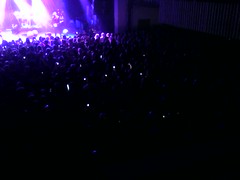
Yes, I went to see Duran Duran last week at the Austin Music Center. I am not really what you would call a fan, but my companion was, so we went to the (appallingly unfinished) AMC to catch the band. The most striking thing about the concert -- besides the fact that they didn't play Hungry Like the Wolf -- wasn't on stage, it was in the crowd. Here's what things looked like before the band took the stage:

Empty stage at Duran Duran concert
And here's how it looked once the band took the stage:
Duran Duran takes the stage
 Duran Duran - left side of crowd Duran Duran - right side of crowd
Dozens and dozens of mobile devices snapped open and started taking pictures and video. And they stayed open for nearly the entire concert. The band (and the bouncers) didn't even blink. Gone are the days of trying to stop bootlegging -- a virtual impossibility now that nearly every phone can take live video and photos. What's more, I saw some of the crowd using their devices as periscopes, angling them high above the rest of the crowd to get a ten-foot view. I'm quite sure the people with actual cameras were zooming in as well.

Here's something else. You've tried talking during a concert? Doesn't work well. My companion and I shared a phone, tapping text messages to each other and reading them off the screen rather than sending them.

So what? Just an observation that these ubiquitous mobile devices are seeping unnoticed into every activity. It's not like the people in the crowd had to think hard about using their devices in this context -- the use was obvious, and pulling the devices out was ... a reflex, the door to finding treasure in the dark.

Blogged with Flock

I plan to cut off voice communication...

Classic exchange about texting. I sometimes wonder if, like this guy, I should just get a two-way pager plus Internet appliance.

Smart Mobs » Blog Archive » New York City texting plunging towards… something

Blogged with Flock

I'm a loser

At FastCompany, Chris Dannon argues that using the social browser Flock makes you a loser. Take a look at his argument and you'll see that what he's mapping out is his own limitations, including what appears to be an appalling lack of focus.

Technology: Are You A Loser?

Blogged with Flock

Monday, December 17, 2007

This is a job for the talking snowman

On the heels of the recent YouTube debates, in which ordinary citizens (and sometimes operatives from rival campaigns) could submit questions for presidential candidates to answer during debates, Al Qaeda's own Ayman al-Zahwahiri is inviting the public to submit questions that he will then answer in an online interview.

How surreal. I wonder if Chris Dodd will submit something?

Ask Al Qaeda Anything! | Danger Room from Wired.com

Blogged with Flock

Yahoo's political dashboard

Succinct and useful.

Political Dashboard - 2008 Presidential Election on Yahoo! News

Blogged with Flock

Velocity matters

This NYT article tries to think big about Google's cloud computing strategy, and generally doesn't get too far. But it has flashes like this one (my emphasis):
MR. SCHMIDT readily concedes that cloud computing won’t happen overnight. Big companies change habits slowly, as do older consumers. Clever software is needed — and under development, he says — to overcome other shortcomings like the “airplane issue,” or how users can keep working when they find themselves unable to get online.

Yet small and midsize companies, as well as universities and individuals — in other words, a majority of computer users — could shift toward Web-based cloud computing fairly quickly, Mr. Schmidt contends. Small businesses, he says, could greatly reduce their costs and technology headaches by adopting the Web offerings now available from Google and others.

“It makes no sense to run your own computers if you are a small business starting up,” he says. “You’d be crazy to buy packaged software.”
Right, but more importantly, Google has focused on the collaborative aspects that have moved to the fore in small businesses. We're seeing a lot of knowledge work being carried out by sole proprietorships and contractors who come together in federations, complete a job, and dissolve again. Prime examples include graphic design and web design, and not surprisingly one of the big early successes in this realm was 37Signals' Basecamp. Google's apps, particularly its office apps, are all aimed at supporting this sort of collaboration. Microsoft, on the other hand, is busily protecting its turf on the desktop, and that hampers it from embracing cloud computing and the collaborative features that go with it -- MS does try to build in those features, but they work against the desktop-centric long-term strategy it has embraced. As broadband penetration becomes deeper and broader, the limits of that strategy will show themselves. Google will not necessarily win in the cloud computing market, but it's the pioneer.
Google Gets Ready to Rumble With Microsoft - New York Times

Blogged with Flock

Friday, December 14, 2007

Taser party!

By women, for women, modeled after Tupperware parties.
She has had parties in Phoenix and Scottsdale by invitation. Guests have the opportunity to shoot the Taser for the first time at a cardboard cutout during the parties. For safety reasons, no alcohol is served and no one is actually Tasered.
Tasers: The Tupperware of 2007 | Danger Room from Wired.com

Blogged with Flock

Online word processor roundup

At lifehack.org:

Write Here, Write Now, Write Anywhere: 13 Free Web-Based Word Processors - lifehack.org

Blogged with Flock

Collaborating on writing projects

Early this year I put together a presentation for the Lyndon B. Johnson School of Public Affairs about collaboratively writing reports. Writing teachers -- and, I think, many in other fields -- tend to assign group projects without offering any guidance on how to plan, coordinate, or collaborate on them. No wonder students hate them. My presentation describes two complementary ways to deal with this issue:
  • planning the project strategically
  • using collaboration software
I've used this in my writing classes as well, and the results have been generally positive. What do you think? Leave feedback in the comments section.

Facebook more cluttered than MySpace

MySpace always seems to be designed like the Sunday Wal-Mart circular. But thanks to the proliferation of third-party apps, one user says, Facebook is now worse.

Ladies And Gentleman, I Present To You: Facebook Hell at franticindustries - web 2.0, social networking, IT technology trends.

Blogged with Flock

Thursday, December 13, 2007

The Battle of the Book

Via Ann Althouse: The New Republic's editors have written a poor defense of traditional books, an unthinkingly conservative argument that confuses a particular medium with great literature -- and great literature with worthwhile reading. I have no brief against books, but TNR's argument amounts to hand-waving generalities underpinned by warrants that are generally indefensible.

In Althouse's comments:
A good comeback is "How can you call it reading if it's not carved on a clay tablet or a written with a feather on a papyrus scroll?"

The Battle of the Book

Blogged with Flock

Tuesday, December 11, 2007

Gun plus person plus God

The recent story of an averted massacre at New Life Church in Colorado Springs made me think of Latour's famous discussion of guns in Pandora's Hope. Latour examined the dueling arguments that have often framed the left-right debate on gun control:
  • "Guns kill people"
  • "Guns don't kill people, people kill people."
Neither frame is satisfactory, he says, because they locate agency entirely in a human or a nonhuman. Instead, he argues, we have to think in terms of a hybrid: gun plus person. The gun can't fire itself; the person can't kill as readily by herself; put the two together and you have a complex or assemblage that acts in a way that the individual components don't.

Latour's formulation gets interestingly complicated by the story of the volunteer guard, a former police officer who responded to the gunman -- who had over a thousand rounds of ammunition and an assault rifle -- and faced him down with a handgun. She credits the Holy Spirit for keeping her hands steady.
"I was praying to God that he direct me" in what to do in life, Assam said. "God made me strong."
Gun plus person plus God? You don't have to believe in God to think that this is an interesting phenomenon. Did the guard's faith in God cause her to act differently from how she would have acted without it? Clearly. What else gets folded into such assemblages?

Security Guard: 'God Guided Me And Protected Me' - Denver News Story - KMGH Denver

Blogged with Flock