Friday, March 23, 2007

EditGrid

Haven't tried it, but lifehack.org loves it and says it's light years ahead of Google Spreadsheets. Killer feature: You can embed spreadsheets in normal pages, just as you would with a YouTube video.

Review: EditGrid a web based spreadsheet application - lifehack.org

technorati tags:, ,

Blogged with Flock

"Clearly, the movie is propaganda -- extremely well-done propaganda -- but propaganda can be used to sell what is true."

Ann Althouse watches An Inconvenient Truth.

Althouse: I'm going to watch "An Inconvenient Truth."

technorati tags:, ,

Blogged with Flock

"That may be good messaging to stockholders, but it isn’t what the public cares about."

Michael Arrington puts his finger on the problem with the unnamed NBC-NewsCorp joint venture that aims to challenge YouTube:

The two key messages Chernin and Zucker were selling were (1) afocus on respecting copyright, and (2) the fact that they were creatingwhat they called “the largest advertising platform on earth.” That maybe good messaging to stockholders, but it isn’t what the public caresabout.

I think a better approach would have been to focus on the userexperience, but this was hardly mentioned (except at one point whenZucker said “we are shocked at the willingness of the consumer to sitthrough the whole show with ads on NBC.com”). It’s either arrogance orit’s blindness to the reality of this Bittorent and YouTube world.Either way, it suggests they are in over their head.

He also reminds us of the history of similar ventures: "As Valleywag pointed outtoday, EMI, BMG, and Sony Music banded together in 1999 to deal withthe Napster situation and created Musicnet, which was a dismal failureand was named by PC World as one of the worst tech products of all time."

Dear Clown Co.: Name This Thing Fast Before Its Too Late


technorati tags:,

Blogged with Flock

Thursday, March 22, 2007

TechCrunch on Twitter

Michael Arrington took the plunge.

(what about the reading list?)

Since combining my two blogs, I've been blogging heavily about net work and its permutations. But I also blog everything I read -- right? What's happened to the book reviews?

Well, what's happened has been the ebb and flow of the job. Right now I'm trying to finish up several projects that are all competing for my attention. So I have one book that I've been meaning to review for weeks, and another that I'm half through and haven't been able to finish for weeks. I haven't given up on that aspect of the blog, I just haven't had time to do the necessary reading. So that's the ebb. Expect the flow this summer.

Tuesday, March 20, 2007

Socrates' student evals

You have to read them. They're pretty much what you'd expect, and I found myself sympathizing primarily with the students. Via Ann Althouse.

Althouse: "Socrates is a real drag, I don't know how in hell he ever got tenure. He makes students feel bad by criticizing them all the time."

technorati tags:

Blogged with Flock

Finally, my thoughts on Twitter.

I'm not in love with Twitter, but I've been thinking about it a lot over the last few days. Why? Because, unlike some critics, I think there's a big difference between the prevalent use of Twitter ("I'm waking up now!" "I'm having breakfast!") and the potential uses for this sort of medium. That is, I see Twitter and similar services as a medium rather than a genre; it's a launching point for possible new and hybrid genres.

Because of that, I'm not terribly worried that Twitter use is seeing a precipitous drop in the UK and a leveling after the SXSWi peak. There's plenty of room for stabilization and diversification of use:
From this totally ad hoc and uncontrolled experiment - and this is not a criticism of Twitter - it appears that relatively speaking, Twitter is more a channel for annotating one's daily activities than it is to express opinions (at least, if we take politics as an example of a space in which people could express opinion). That is going to change. There are a number of institutions which are starting to use Twitter to channel hooks to their content - e.g. news sites either by themselves or via some third party mashing are starting to publish content to Twitter. This will likely impact the topical space of Twitter content.
Certainly we're seeing applications in lifestreaming, auto-event notification, and professional work as well as more mundane uses. I agree with Peter Merholtz that those uses could be radically expanded if Twitter were to include event handling (think conferences) as well as differential permissions. One of the reasons it was such a big hit at SXSWi was that conferencegoers could silently share messages with each other. Those messages were occasionally egocentric, but more often contributed to a larger understanding of the conference. If you have Twitter sending texts to your phone, or you're monitoring it on your laptop, you find out what's going on in the other conference sessions as they happen -- what's interesting, what's lame. You also find out when and where freebies are being passed out, if you're into that sort of thing. (I have enough T-shirts, so I passed on that.)

The killer app for Twitter at conferences, though, was in the evening. Whose party is currently heating up, and whose is cooling down? Does the Lifehacker party really have an open bar? (Yes.) Does the PayPal party require preregistration like they said? (Yes, but they are currently bending the rules.)

Keeping all this in mind, here's a quick set of uses for Twitter or similar services. If you're at Twitter, think hard about these; if you're not, think about creating a similar service that meshes SMS, IM, and WWW.

Private (cohort) uses:
  • Collaborative time logging. See what's going on with others working on the same project. Could contribute to overall awareness in a more fine-grained way than Basecamp or other collaborative project management systems do.
  • Events management. So you're coordinating SIGDOC 2007 and you want to keep apprised of important occurrences while you're in a session? Put your phone on vibrate and enable Twitter.
  • Swarming. The WTO protests in Seattle were coordinated by cell phone. Similar street-level political action could be coordinated more effectively, and awareness could be more distributed, by something like Twitter.
Public uses:
  • Workstreaming. Not just for ego, but to communicate work and work habits to potential clients. Important especially for contractors and small businesses.
  • Clubbing, church, or other activities in which it's hard to coordinate due to noise and distance constraints.
  • Conference-going.

Freecycle, Craigslist

I don't do garage sales anymore -- you generally make a few cents an hour and have to deal with people who treat you like a shopkeeper -- but how else can I get rid of all the junk I just purged from my garage? Freecycle and Craigslist have been invaluable in this regard. If something has little to no intrinsic value, we Freecycle it: someone always wants whatever you need to give away (an exercise bar? a Pentium-class computer with no hard drive?). If it has a little value, we Craigslist it (that old weight bench that we never use). Transactions are one-to-one, facilitated with low-friction software, and managed by email. And NO EARLY BIRDS.

Bruno Latour is trapped in a fortune cookie factory

"A leader is powerful to the degree he empowers others." -- Fortune in the fortune cookie I got at Kim Phung last week.

Monday, March 19, 2007

"This is going to be an expensive campaign season, but if you are doing a fundraiser, then campaign for some votes too."

At Burnt Orange, they're upset that Hillary Clinton is holding big-dollar fundraisers in Austin rather than spending much time rallying support:

This is going to be an expensive primary and an even more expensive general election. But why take Texas for granted? Texas may or may not be one of the many states to have a February 5 primary, and there is little to no cost to have a public event.

There is no rational to jet in, take huge sums of cash, and then leave with out talking to voters.

2008 can be summed up as a wide open field. The Democrats have a deep bench of candidates running this year. Why only talk to donors and not voters?

I love the great state of Texas, but I don't blame Clinton's strategy. In the primaries, I think it's rather unlikely that Texas will bump up from Super Tuesday in the coming cycle, so Clinton is concentrating on knocking out the opposition before then. And in the general election, Clinton is not following Dean's controversial fifty-state strategy.

Comparing project management systems

My sysadmin passed me this head-to-head-to-head comparison. I haven't used Goplan yet, but the assessments of the other two seem correct.

Basecamp, activeCollab, and Goplan compared

technorati tags:, , ,

Blogged with Flock

Sunday, March 18, 2007

Twitter roundup

I'm still thinking about Twitter, not because I think it's a fantastic app but because it, or something like it, seems to have real potential as an infrastructure on which many possible uses can be built. More thoughts soon, but here's my bookmarks.

Thursday, March 15, 2007

Wednesday, March 14, 2007

Another killer app for Twitter ...

... would be team celebrity stalking. They should crossmarket with Gawker Stalker.

SXSWi photos are up

Although they're not much to look at.

Enterprise dashboards and mashups

A natural fit. Okay, now add workstreaming ...

Mashups on Enterprise Dashboards - Is Mash-Dash the 2.0 of Enterprise Dashboards?


technorati tags:, , , ,

Blogged with Flock

My lifestreaming experiment

My lifestreaming experiment is a lot less intrusive and a lot more hacked together than those I mentioned in the last post, but it's a quick-and-dirty proof of concept using my personal online presence. Basically, I just threw all of my feeds into the Drupal aggregator and made the stream my homepage. I have to say it does make my site more dynamic. Comments?

Added: I've moved the workstream (not really a lifestream after all) to a subpage so that I could advertise two important calls for papers on my front page. I've also added a stream from my Twitter account, but with some trepidation.

Lifestreaming

A little while ago I blogged about workstreaming, "the publishing of work-related activities and events to your remote colleagues, usually via RSS but sometimes in other formats and ways." My flagger pointed to a similar but expansive phenomenon, known variously as lifestreaming or datastreaming or lifelogging.

The idea is that we're online so much, and logging so much of our existence via separate services, that we should be able to compile a timestamped record of our online existence. And since that existence intersects heavily with offline existence, we can do all sorts of autotracking, providing a second memory of our activities. Emily Chang describes it this way:
For now, this activity stream idea is providing the start to a holistic view of my activity across online networks: both my own and the ones I use. In turn, this acts as a conduit for you, the reader. Rather than just a static “recommended links” page or a blogroll, the data stream opens up my activity to you in semi-realtime and at one website. I’ll continue tweaking the content, navigation, and layout so watch for changes. Let me know what you think!
I haven't yet let her know what I think, partially because I'm still thinking through the concept. On the one hand, this seems like a natural progression in the context of net work, in which barriers between work, social, and civic lives tend to fall and in which constant collaboration and communication become necessary for sustaining the sorts of boundary-spanning we have to do. Chang runs a web consultancy (among many other things) and it makes sense that clients, contractors, vendors, etc. know what she's up to. So tracking her location on Plazes, seeing her social chatter on Twitter, and viewing her planned events on Upcoming -- all in one place -- seems like a tremendous resource. Furthermore, a datastream like this obviates the need for other sorts of time tracking for projects; the data are all there, they just need to be tagged or otherwise characterized.

On the other hand, lifestreaming seems to be giving away a lot of privacy, and reviewing her datastream makes me feel like a stalker. I can't imagine sharing this much information with the world. But I suppose we all can and do edit what we feel comfortable sharing. Maybe I'll try something similar with the information I'm already putting out there.

Tuesday, March 13, 2007

Twitter at SXSWi

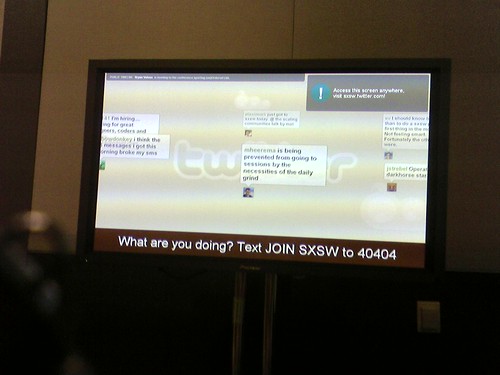
One of the first things I noticed when walking into the lobby on Friday was a big screen showing icons floating from left to right, displaying thought bubbles. This display was courtesy of Twitter, a social networking site that consists entirely of redirecting IMs and text messages to group displays. In practice, this means that people would text or IM their thoughts to Twitter during the sessions and those thoughts would show up on the big screen in the hall outside. They would also be broadcast to friends of those people.

Great, but what on earth is it useful for? In a convention context, it could have been useful if I had been trying to coordinate activities with a small cadre of friends. Suppose that my friends and I are attending different sessions. If my session is not good, I text that fact to Twitter. If it's great, I text that instead. The result: we can loosely coordinate swarming without making disruptive voice calls or individually setting up texting lists. (SXSWi is much looser than academic conferences about changing rooms.)

But there's an analogous but much more direct application. Last night I was at the Lifehacker party and I started getting Twitter traffic reporting on the various parties. The traffic mostly had to do with (a) which parties were lame and (b) which parties had free drinks. Let's call it a "beer swarm." And this use was even better, since texting is much preferable to voice calls in a loud party context and since these texts are applicable to a far wider range of friends. There's your killer app. I don't think that Twitter will take off in an office context, but in contexts where you have to silently coordinate an all-channels network, it fits the bill.

Recovering from SXSW

I've been at South by Southwest Interactive since Friday evening, and am just exhausted. As usual, conferences that take place in one's home town are harder than conferences located elsewhere, since you have to make rapid transitions and divide your attentions. But I was still able to attend some great panels (and some not-so-great ones), meet some great people, and think a lot about the future of mediated interaction.

Since I won't be going to CCCC/ATTW next week, I'll be taking the next week and a half to digest what went on, summarize my notes, and add some thoughts on SXSW. It's a really interesting conference, with much more vendor stuff than you normally see at academic conferences, some surprising depth in some areas, and some surprising thinness in others. All in all, it was invigorating, and I'll probably go again.

SXSWi posts will be tagged "sxswi2007."